Showing posts with label movie reviews. Show all posts

Tuesday, October 5, 2010

The Social Network review

As you may or may not have already heard, The Social Network is an enormous critical hit. I honestly can't recall the last time I saw a movie that was so widely acclaimed, which is particularly impressive considering it's a feature length movie about motherfucking Facebook. It actually reminds me a bit of when Brokeback Mountain was announced and endured 15 months of gay cowboy snark before being rapturously received upon its actual release. Granted, Brokeback Mountain seems to have since had more of a shelf-life as a punchline, because making jokes about gay people never goes out of vogue, and maybe in five years no one will remember why everyone thought that a movie about Facebook was so great, but right now, it's a pretty big deal.

I saw The Social Network over the weekend. I liked it a lot, and I think it's a great movie. In the couple days since I saw it, though, I've been doing a lot of thinking about exactly why it's a great movie and I've found it pretty difficult to pinpoint. Part of the issue is that The Social Network is supposed to be a movie about the founding of Facebook, but it's not really primarily concerned with telling that story as a dramatic narrative. It's really more of a character piece that focuses tightly on Jesse Eisenberg's portrayal of Mark Zuckerberg. One of the most interesting things about the movie is the way it purposefully ignores depicting the larger context and effects of Facebook, even though the exploding popularity of the site is the major driver of the narrative. There's no montage of college students at their computers getting hooked into the Facebook phenomenon, or anything comparable to dramatize the network's broadening impact besides snatches of dialogue and other exchanges.

It's a smart decision, because no moviegoing audience in 2010 needs to be told that Facebook is a big deal. It also reflects the clear fact that nobody involved in the making of this movie gives two shits about Facebook. That's understandable, but where it really gets interesting is that The Social Network also doesn't seem to be terribly concerned with being about Mark Zuckerberg, insofar as Mark Zuckerberg is an actual human being, who actually exists, founded, and runs Facebook. Comparing The Social Network to Citizen Kane feels like somewhat of a cliche already, but thinking about The Social Network as something of a goof on the narrative structure of Kane is really the most useful framework I can conjure to discuss it. Both movies tell the story of the rise of wealthy men, but do so mainly through the perspectives of others. This latter fact isn't entirely obvious in The Social Network, mostly because Zuckerberg's character is alive and present during the telling of the story while C.F. Kane is dead, but it's clear that the framing device of The Social Network (two depositions regarding lawsuits filed against Zuckerberg) signals that the storytelling reflects the biases of the plaintiffs on key points, rather than objective reality. Basically, The Social Network has two main characters: "Mark Zuckerberg," an asshole computer genius who may or may not have screwed over other people on his way to creating a world-beating Internet company, and Mark Zuckerberg, an asshole computer genius who points out various flaws and inconsistencies about the story of the first character as it's being told.

The reason that I called The Social Network a goof on Citizen Kane's narrative is that while Kane  explores the flaws and complexity of its main character in an ultimately futile quest to arrive at a larger understanding of his identity, The Social Network doesn't really ask any questions about Mark Zuckerberg at all. Eisenberg's portrayal of Zuckerberg is a fascinating character to watch onscreen, but more because of his lack of complexity than because of the presence of it. The character can be essentially summarized by extremes of two traits: intelligence and self-absorption, and it's the latter that really seems to be of the most interest to the filmmakers. I think it's entirely fair to argue that The Social Network is about solipsism more than it's about anything else. The genius move is that the movie explores this by focusing entirely on the founder (s?) of Facebook while ignoring the users entirely. If Fincher and Sorkin explicitly said that social network addicts are disappearing up their own asses, The Social Network would probably have come off as reactionary bullshit. Instead, by weaving a creation myth by which Facebook was born out of a series of interlocking acts of self-absorption, they make the argument by proxy. The Social Network's Mark Zuckerberg isn't really a person as much as he is an avatar of a perceived generational flaw. As arresting as the closing image of the film is, it struck me as more of a red herring than a character insight - I don't believe Fincher or Sorkin think they're explaining anything substantial with it; just like Charlie Kane's secrets weren't really unlocked by that sled. (It may be a similar added "fuck you" to the character's real-life counterpart, though: The Social Network is pretty blatantly drawing on shopworn computer geek stereotypes, and "Rosebud" was William Hearst's secret nickname for his mistress's vagina).

I realize that all of this was probably pretty incoherent if you haven't seen The Social Network yet, so here's a couple general sentiments about the movie itself: the acting is phenomenal, the composition and cinematography is stunning and doubly so considering it's an entirely dialog driven movie about computers, the score is great, and it features movie history's hands-down most convincing use to date of one actor playing both halves of a pair of twins. Go see it already.

Saturday, June 5, 2010

Jennifer's Body liveblog

In something of a departure from my usual way of doing this, i.e. pick the worst movie I can find and mock it mercilessly, this week I'm watching Jennifer's Body, which was basically a critical and commercial failure, but never stuck out to me as an obvious misfire based on the previews. Actually, it seemed like it had several pretty smart ideas. In a lot of ways, horror is one of the more prominent movie genres in terms of utilizing female protagonists, so the concept of introducing a female antagonist and possibly subverting the retrograde sexual politics that are a more regrettable horror touchstone is a promising one. The fact that it was written by Diablo Cody of Juno fame seemed like it could either be a big strength or a big weakness depending on the whether the dialogue stays on the right line of "clever" versus "too clever by half." I know most of the critics felt that it was the latter, but I'm not going to rule out the possibility that I might actually like this movie.

0:00: Then again, the only quote on the back of the DVD box is from horror.com, and it reads "Sexy... and chilling!" which gives me pause, because what the hell could they have left out of that sentence with the ellipses? I looked up the actual review out of curiosity (it's positive) and the full quote is "Some of the lines in the film are probably better-read than said, but if you pay close attention to what's being said, you'll be much enriched by this very sexy, over-the-top and sometimes even chilling horror comedy." Does the fact that they left out the "very" on the box make up for leaving out the "sometimes?"


0:00: An early point in this movie's favor: it's only 102 minutes long. My rule of thumb is that a horror movie ought to be 90 plus-or-minus 10 minutes.


1:00: We open on a Halloween ripoff POV shot outside of Megan Fox's house, and a voiceover line "Hell is a teenage girl." If you're going to steal from The Virgin Suicides, might as well not make it subtle.


2:15: We find out that the VO belongs to Amanda Seyfried, who always kind of looked like a space alien to me. She's in a mental institution acting like a badass. "I wasn't always this cracked." Unnecessary framing device alert!


5:34: We're gradually getting to the actual story. There's some silly tidbit about how the town's waterfall has some sort of extradimensional vortex. 


6:45: This movie doesn't waste any time making the lesbian undertones between the lead characters ragingly explicit. Now Amanda Seyfried's boyfriend is saying "You do everything Jennifer says." Also, Amanda Seyfried's character is named Needy. They're going to a rock show in the sticks so Megan Fox can try to fuck the lead singer.


12:00: Megan Fox to Amanda Seyfried, re: breasts: "These things are like smart bombs. Point them in the right direction and shit gets real." Score one point for too clever by half.


14:00: Amanda Seyfried is salty because she overheard the lead singer talking about how he wants to fuck Megan Fox and tells him off.


15:00: I don't agree with the decision to have the fake band, who combines the look of Interpol with the sound of generic early 2000s pop-punk, play a song. More lesbian undertones ensure. Then the bar lights on fire a la the infamous Deep Purple incident of 2002. Megan Fox is in some sort of trance and the band guys haul her off to their van while the bar explodes in the background.


21:00: This is actually kind of boring so far. Isn't the point of being thuddingly obvious with character development that it lets you bypass this sort of gradual story development.


22:05: Now Amanda Seyfried is back at home and walking around the house in generic slow-burn horror mode when Megan Fox sneaks up on her, all bloody and evil looking, which almost looks creepy. Then she pukes out a bunch of black oil, which is kind of ridiculous-looking. After that, Megan Fox throws Amanda Seyfried against a wall and feels her up, then leaves. 


26:00: Now it's the next day in school, and Megan Fox appears to be back to normal, but we can tell she's not because slightly more of a bitch than usual.


26:45: J.K. Simmons is in this as kind of a hippie-ish teacher who's missing a hand. He's wearing a comical looking curly wig.


30:15: Did Diablo Cody actually go to high school? Based on these scenes, which make The Faculty look like a Fredrick Wiseman documentary, I'd say no.


32:05: Now Megan Fox is luring a lunkhead football player, who's grieving the loss of his friend in the fire last night, into the woods to make out. CGI wildlife surrounds them, because otherwise this scene might acquire a bit of tension. Megan Fox takes off her shirt and gives the football player a handjob, then her mouth splits open to reveal fangs and she bites him to death.


35:45: The problem with this movie is that it wants to be a horror comedy, but the comedy aspects completely undermine the horror part because there's no effort made to make the characters coherent or realistic and the movie pretty openly mocks the gravity of the deaths.


41:35: This movie is supposed to be set in Minnesota? And no funny accents? That's a missed opportunity.


46:15: Now Amanda Seyfried and her boyfriend are going to fuck as part of a montage set to a pop-punk cover of Johnny Nash's "I Can See Clearly Now. " Movie soundtracks tend to date the films they're attached to, but rarely do they date them to several fucking years before the film was actually produced. Also, Megan Fox is luring in her next high school stereotype, a Goth kid, into a boarded-up house. This is intercut with a joke about Amanda Seyfried's boyfriend fumbling to put on a condom, again because this movie would hate to build or sustain any sort of tension.


52:14: I should point out that Megan Fox and Amanda Seyfried are actually nailing their roles here. It's the writing, directing, and editing that's sinking this movie.


53:22: Now Amanda Seyfried realizes, mid-coitus, that Megan Fox is the killer, through some sort of lesbian psychic hallucination link. She gets in her car to drive home and Megan Fox appears in the road and attacks her for some reason.


58:30: Amanda Seyfried gets home and walks around a little bit before going to bed. Megan Fox is waiting there! They make out, because Diablo Cody probably hasn't heard of Internet porn and thought that would be enough to get every horny man in America to see this underwhelming movie. 

1:00:32: Then Megan Fox reveals that the band from the burned down club were actually a Satanic cult of some sort, as if we hadn't figured that out 45 minutes ago. There's a lengthy cutaway dramatizing these events, which are apparently undertaken as a sacrifice to make the band famous "like Maroon 5." LOL! Megan Fox actually gives a really convincing portrayal of distress and violation. Unfortunately, everybody else in the scene is in a completely different movie, one where they're singing Tommy Tutone's "867-5309/Jenny." Yes, really.


1:08:23: Well, that was an unnecessary ten minutes that basically served to retroactively undo the lone element of subtlety contained in this movie to date!

1:09:15: Now Amanda Seyfried's doing paranormal research in the high-school library. I have a feeling that there's going to be a knowing ironic reference to this coming up.


1:12:35: Disco.


1:12:50: The climax is going to be at the school formal, because inviting comparison to Carrie is a great idea.


1:14:30: The woman who played Dylan Baker's wife in Happiness is in this shit!


1:17:43: Now Megan Fox is stalking Amanda Seyfried's boyfriend, who didn't believe her earlier when she warned him that Megan Fox was actually a demonic succubus. Also, the Satanic band is playing at the school formal. 

1:21:40: Amanda Seyfried realizes that Megan Fox is probably trying to kill her boyfriend. Instead, she's lured him into an indoor swimming pool that's overgrown with trees on the inside for some reason. Amanda Seyfried's boyfriend decides he doesn't want to kiss Megan Fox because he's still in love with Amanda Seyfried, so she gets pissed and uses her succubus teeth to bite him just before Amanda Seyfried arrives.


1:25:09: Now Amanda Seyfried maces Megan Fox, who does the vomiting thing again and starts to levitate. Then the two of them get into some sort of dialogue about insecurity and female friendship, which I guess was inevitable. Then Amanda Seyfried's boyfriend impales Megan Fox with the back end of a pool skimmer, but instead of dying, she asks Amanda Seyfried for a tampon and then leaves. Amanda Seyfried's boyfriend dies but tells her he loves her first, which I guess is going to restore her self-esteem to the superpower levels that she'll need to take on Megan Fox.


1:30:00: Now we're back to where we were at the beginning of the movie for the climactic showdown, which is sort of an quasi-Exorcist levitation deal over Megan Fox's bed, where Amanda Seyfried rips off Megan Fox's BFF necklace and stabs her in the heart with box cutters, which I guess she read about as being the way to kill a succubus in the school library.


1:33:25: Now we're back to the pointless framing device in the insane asylum, where we learn that Amanda Seyfried "absorbed some of the demon's abilities."  She levitates herself out of the insane asylum, in what would be a logical ending to the movie. It does not, in fact, end.


1:35:35: Now Amanda Seyfried's hitchhiking out to take her revenge on the Satanic rock band, the aftermath of which is shown in flashes over the closing credits, Dawn of the Dead remake style. Remarkably, this movie hadn't used a Hole song on the soundtrack until this point. 


Final thoughts: Jesus, what a misfire. The shame of this is that, like I said before, the basic idea of this movie is really strong. Also, the leads are just about perfect - I think that Megan Fox and Amanda Seyfried would absolutely still be the stars of this movie if it were done right. The problem is the writing, which never really seems to aspire to be creepy or scary and instead goes for wall to wall exaggerated quipping. If you rolled your eyes at the "Honest to blog" line in Juno, you'll probably want to throw your DVD player out of the window by the time you get to the point in Jennifer's Body where Megan Fox tells Amanda Seyfried to "move on dot org." Compounding the problem is the direction, which borrows camera moves and staging from other and better horror movies but never really tries to wrestle the script into anything resembling a tone. I could always be wrong about this, but I'd be surprised if this movie finds the cult audience that it's so obviously going for (speaking of which, do these prefab cult movies ever actually wind up working out in that way?)

Sunday, May 23, 2010

Suspect Zero liveblog

I wasn't sure if I was going to do one of these this week, but it so happens that I was cruising Netflix Watch Instantly, which functions as an online repository of every shitty movie ever made and twelve or so good ones, when I stumbled across Suspect Zero, which I vaguely recall hearing about at the time of its release. I read the description of the movie, which I'll reproduce verbatim here:
A serial killer is on the loose, and FBI agent Thomas Mackelway is on the case, sifting through clues to uncover the criminal's identity. But there's one unusual twist: The bloodthirsty felon's victims of choice are other serial killers.
I can't pass up a movie that sells itself on its sheer density of serial kilers. Plus, it's in high-def. 

0:30: The credits are in a scratchy font that's overlaid with a distortion effect, which means that this movie has managed to rip-off of Seven before the first scene even begins.

1:15: We open on a diner in the rain, which could also be considered a ripoff of Seven, although I guess Seven doesn't really have a copyright on rain in movies. Although it probably could.

3:43: Ben Kingsley sits down across from a fat man and starts up a stereotypical "crazy person conversation" by asking invasive questions and by showing the fat man some pencil sketches, which I guess we're supposed to assume are crazy person drawings.

5:25: The fat man gets in his car and starts driving away nervously. I wonder how long it's going to take before we find out that he's really a serial killer.

6:55: Ben Kingsley is hiding in the fat man's backseat pulling on surgical gloves! He shows one of his "creepy" drawings and implies that he's going to kill the fat man. End scene. I'm impressed that nobody who made this movie was tempted to put any sort of clever spin in lifting the old killer in the backseat urban legend.

8:15: Hey, Aaron Eckhart's in this movie, playing an FBI agent who's been transferred to Albuquerque from Dallas. The office also contains the guy who played Boyd in Dollhouse and someone who had a bit role on lost.

10:14: Now Aaron Eckhart's getting some strange faxes of missing people marked for his eyes only.

12:15: Aaron Eckhart and Boyd from Dollhouse go to investigate the death of the fat guy from the first scene. The Albuquerque police/FBI are being portrayed as

13:22: Did I mention that the score for this movie is a combination of vaguely Native American woodwinds and chanting? It's clearly supposed to be arty, but it comes off as kind of annoying. Also, Ben Kingsley's doing some sort of guided imagery meditation and having some sort of psychic vision of Aaron Eckhart investigating the dead fat guy's car, which he draws a picture of.

17:13: Now Trinity from The Matrix is here, who is also an FBI agent from Dallas sent to help with the fat guy's murder. They're reviewing pictures of forensic evidence on a table in the middle of a diner. Are they allowed to do that?

20:23: Aaron Eckhart and Trinity from The Matrix are alluding to a boring backstory when they find a dead guy in the trunk of a car in the diner's parking lot with the movie's logo carved into the back of his chest.

21:00: Remember when I said this movie was trying to rip off Seven? I was wrong. It's trying to rip off Twin Peaks. Inexplicably, it's apparently doing so by shooting on the crappiest digital video I've ever seen and having all the actors to deliver their lines with no intonation, and not setting any sort of context for what the hell is going on.

26:12: Aaron Eckhart and Trinity find Ben Kingsley's lair. He has a bunch of clippings of newspapers that detail how Aaron Eckhart got in trouble by arresting a killer in another state without an extradition treaty. This is reiterated in a flashback scene that also intimates that Aaron Eckhart also has psychic powers.

31:10: I need to point out that there appears to have been no attempt whatsoever to employ lighting in this movie.


31:52: Now we're in psychic-vision again (read: a red filter slapped across a canted long-shot) and we're seeing someone who's probably Ben Kingsley sketching Aaron Eckhart's face and writing "Heightened Awareness. Chronic Insomnia. Acute Migranes. He Is The One." Is this all an elaborate clinical trial for Excedrin PM?

32:13: Another arty montage of Ben Kingsley drawing and more psychic visions of Aaron Eckhart doing police stuff.

34:44: More serial killin's afoot! Some redneck abducts a woman in the parking lot of a bar and rapes her in a truck. Then Ben Kingsley shows up, pulls him out of the window of the truck, and kicks his ass, which seems physically improbable. Then he kills him.

37:40: It turns out this victim is the same guy that got off when Aaron Eckhart flagrantly disregarded state jurisdiction statutes. More ambient music and lots of close-ups of Aaron Eckhart's face, presumably conveying his harried emotional state. Aaron Eckhart finds a message left by Ben Kingsley saying "You're Welcome Tom"

41:11: Now they're at the FBI office talking about how the locations of the bodies match GPS coordinates found at Ben Kingsley's old room. I can envision the meeting where the writer and director of this movie are desperately trying to think of plot devices that haven't been used in a thousand other serial killer movies. "I know - GPS coordinates!"

42:28: Now Aaron Eckhart's getting a message from a "professor of criminal biology." What the fuck does that mean? The movie, of course, doesn't bother to even make it sound like a real thing. Aaron Eckhart goes to visit this guy, who has a bunch of Native American crap on his walls. Cue more fucking flute music. The professor of criminal biology explains that Ben Kingsley was once a student of his, his Anakin Skywalker if you will, and that he had a pet theory about somebody he called the "suspect zero," who is basically a serial killer that nobody can tell is a serial killer because he's so good at being a serial killer there's no consistent pattern to the murders.

44:33: Aaron Eckhart asks the professor of criminal biology if Ben Kingsley might be the suspect zero. "That's a plausible theory." Based on this, we can safely assume that there's no way that Ben Kingsley is the real suspect zero and that it's going to turn out to be Aaron Eckhart himself in a shocking twist ending in about 45 minutes. The "he is the one" thing would seem to foreshadow this. Backup possibility: it's Trinity from The Matrix.

47:42: Now Ben Kingsley is at a funeral in a black church and is crying for whatever reason.

49:11: Aaron Eckhart is looking over all of the crazy scribblings that Ben Kingsley has sent him. One of them is a drawing of a vagina. He's also having psychic visions, which are different from Ben Kingsley's because they are grainy black and white.

50:12: Now Aaron Eckhart goes over to Trinity's house (in the rain, natch) and mumbles a bunch of stuff about how he's close to cracking open the case and also expresses some generic torment about his headaches. It's revealed that he and Trinity have a romantic past. Have I mentioned this is a terrible movie?

53:13: Aaron Eckhart goes to question the fat guy's wife again on a hunch, but she can't talk to him for very long because she has a PTA meeting to go to. You'd think she'd take a break from that shit considering her husband just died. As she leaves, Aaron Eckhart notices that Ben Kingsley's sent him a bunch of drawings of the house, so he breaks back into it and finds a big trunk in the attic with a bunch of serial killer stuff. Then in a voiceover scene Aaron Eckhart tells us that the FBI also figures out that the other dead guy who Aaron Eckhart and Trinity found in the car a half-hour ago was also a serial killer. We are now officially caught up to the amount of information that was contained in the two-sentence Netflix summary.

1:00:23: Now Ben Kingsley gets pulled over by a cop and has an essentially pointless conversation where he claims to be a former FBI agent. This was also mentioned earlier. Ben Kingsley sends Aaron Eckhart a message to come over to his weird basement deal. When he gets there, there's a filmstrip playing that basically says that Ben Kingsley really was in the FBI, in some sort of special experimental deal codenamed "Project Icarus" which isn't at all a retarded codename for a special project. Was "Project Hindenburg" already taken?

1:07:08: Ben Kingsley's doing his scribbling thing again, and seeing another psychic vision of what's probably another murder victim, only you can't tell because it's just a kid on a swing who then disappears and his mother starts frantically running around looking for him. During this time, Aaron Eckhart is tearing wallpaper off of a wall for some reason and revealing a mural of a black hole or some shit. Apparently the mural is of all of the murder victims that Ben Kingsley has psychically seen.

1:13:11: Now Aaron Eckhart is trying to convince Trinity and Boyd from Dollhouse that Ben Kingsley is a good guy. Now apparently he's chasing some trucker who's abducting little kids. Yes, all this is supposed to be happening in one part of New Mexico.

1:15:45: Aaron Eckhart starts tracking the child killer using his psychic visions or just happens to catch sight of him on the roadway (I can't tell). Then Ben Kingsley shows up and kidnaps Aaron Eckhart somehow.

1:18:33: Aaron Eckhart's hogtied on the floor and Ben Kingsley is yelling about killing him but doesn't for some reason. Then it cuts to them riding in a car where Ben Kingsley is talking about being psychic and how it sucks because he doesn't know how to not be psychic anymore and he's always seeing murder in his mind. What a crybaby.

1:22:34: They drive to a farm somewhere that has a ton of bodies buried in mounds in the backyard and then Ben Kingsley given Aaron Eckhart a gun and they start to chase the serial killer, who's driving a refrigerated truck. Everybody goes off the road and flips over for reasons that are not evident. Aaron Eckhart chases the serial killer guy on foot while Trinity saves the kidnapped kid. More fruity music plays in the background.

1:29:13: The serial killer trucker manages to get the drop on Aaron Eckhart even though Aaron Eckhart is chasing him through the desert, has a gun, and is psychic. Aaron Eckhart turns the tables and kills the serial killer with a big rock. Then Ben Kingsley drops to his knees and put Aaron Eckhart's gun to his head in an exact replica of the staging of the climactic scene from - yes - Seven.

1:33:15: Ben Kingsley goes into an outrageously hammy speech about how he wants to die because he can't take the psychic visions any more and how he wants Aaron Eckhart to take his place as the new psychic avenger or some such. Aaron Eckhart refuses to kill him, but then Ben Kingsley pulls out his knife to attack him and Trinity shoots him instead.

1:36:11: Ben Kingsley's final words: "So...tired." Me, too. This is one of the most incompetent movies I've ever seen. It's not entertaining-bad, it's hack film-student bad. It didn't even have the decency to shoehorn in a wildly implausible twist ending. Also, I never want to hear Native American music ever again.

Saturday, May 15, 2010

Law Abiding Citizen liveblog

"(I)f trying to be intense and serious and succeeding only in looking completely goddamn ridiculous were an Olympic sport, Law Abiding Citizen would have been crowned its Michael Phelps based solely on the two-and-a-half minute span presented above." Me, after seeing the trailer for Law Abiding Citizen back in August of last year.

Join me to find out how far Gerard Butler will go to avenge his murdered family after being failed by the justice system. My guess: further than Kevin Bacon in Death Sentence, but not as far as Charles Bronson in Death Wish.

0:00: I have a question: how come the main takeaway from the success of 300 was "Gerard Butler should be a major mainstream movie star"? I haven't made a habit of seeing any of his movies since then - maybe I'm missing out, and The Ugly Truth is actually a new-era The Philadelphia Story - but he strikes me as a puffier Russell Crowe with the fratboy aloofness of Vince Vaughn. Now that I think about it, I guess I can see why a casting director would go for something like that. Though I wonder how he's going to fare in the Sam Worthington era.

0:00: Fun fact: Law Abiding Citizen was written by Kurt Wimmer, the writer/director of the underrated Equilibrium, which achieved a kind of greatness due to featuring some seriously inventive action sequences and Christian Bale in full-on overachiever mode. I don't know if the writing really distinguished itself in that one, though.

1:34: Gerard Butler gets hit in the face with a baseball bat by some robbers after a whopping 42 seconds of character establishment (summary: he has a cute family). The robbers rape his wife and kill his kid, but don't appear to actually steal anything except for a trophy from the mantelplace, presumably awarded to Gerard Butler for Family Least Likely To Be Killed.

3:35: Now we open on ambitious young prosecutor Jamie Foxx, being ambitious and young. He decides that he can't take the risk of prosecuting both the robbers, so he makes a deal to send one of them to Death Row while convicting the other one on a lesser charge. "This is just how the justice system works!" Gerard Butler is sad.

9:12: Now the deal is closed, and of course the more evil robber is the one that has the lighter sentence. The more evil robber shakes Jamie Foxx's hand and says "It's nice when the system works" in an evil voice. Oh, the irony! Gerard Butler looks on with a look of slight annoyance.

11:34: Now Jamie Foxx is talking to his pregnant wife's belly.

11:55: TEN YEARS LATER - this movie really doesn't waste a lot of time on exposition. Now Jamie Foxx is a slightly older but still ambitious prosecutor. His wife is bitching at him about never making it to their kid's piano recitals because he's so invested in his work.

14:00: It turns out that he's going to the execution of the less-evil robber that was sentenced to death, because he totally has to be there and couldn't possibly miss that to see his daughter play in a recital. There's some classy intercutting between the recital and the execution that probably should have been a match on action, but isn't.

14:15: This movie's commitment to not trying to make its actors look 10 years older despite having flashed forward ten years is truly impressive.

16:15: The execution goes bad! It's supposed to be a basic painless lethal injection, but instead it causes the less evil robber's heart to explode! Jamie Foxx is not happy and wants answers.

20:34: Now the more evil robber is running from the cops because they want to question him. But Gerard Butler calls him on his cellphone using the voice masking deal from Scream and guides him to safety. Then he pretends to be a cop using a wig and fake mustache and lets himself be captured by the more evil robber, only it's really a setup so Gerard Butler can turn the tables on him by letting the robber steal a fake gun that has spikes that come out of the grip.

22:00: The more evil robber is paralyzed with "toxin from a Caribbean puffer fish" that immobilizes him but still lets him feel pain. Gerard Butler does some Saw type torture stuff and cuts the more evil robber up into pieces.

24:19: The prosecutor team is now trying to figure out who could have messed with the lethal injection device. This is not what the intro to Law & Order (RIP) let me to believe prosecutors do. They find out that the more evil robber has been chopped up in a warehouse owned by Gerard Butler. We also learn that Gerard Butler is a "tinkerer" who holds "19 patents" which I think is shorthand for "super-genius." 

29:15: Now they're off to arrest Gerard Butler, who takes his shirt off before the cops get there for some reason. He's wearing the bracelet his daughter gave him in the first 30 seconds of the movie. The prosecutors are helping to search the crime scene, because there are no other crimes in the city of Philadelphia that need their attention.

31:20: "We have zero evidence. We're going to need a confession!" Isn't the clear motive and the fact that the murder was committed on his property enough to make a case?

32:10: Jamie Foxx's daughter gets a DVD that she thinks is of her recital but is actually of Gerard Butler carving up the more evil robber.

33:30: Jamie Foxx is now interrogating Gerard Butler in the middle of a comically overlarge cell that looks like something from the third act of The Silence of the Lambs.


34:20: "You might want to cancel your 12:30 lunch with Judge Roberts." Gerard Butler really is a super-genius! He must have hacked into Jamie Foxx's Outlook calendar.

36:15: "You've got me confused, I don't deal with prison stuff." - Jamie Foxx, who based on what we've seen so far does pretty much everything except prosecute criminals, including probably planning the meals in the prison cafeteria.

38:15: Now they're trying to trace Gerard Butler's holdings, which are registered through a Panamanian dummy corporation.You can tell the movie is trying to make a half-assed nod to real police work here, while hoping that the viewer doesn't know what prosecutors actually do.


40:35: This movie is kind of a rip-off of the little remembered Anthony Hopkins-Ryan Gosling movie Fracture, which was itself kind of a rip-off of Primal Fear.

41:00: We see Jamie Foxx doing some actual prosecuting! More specifically, requesting that Gerard Butler not be granted bail. Gerard Butler gives a speech in his defense, which uses the words "law abiding citizen," and cites precedent. The judge is impressed and looks ready to grant him bail. Then he gives another speech about how the justice system is too lenient and says to the judge "I feed you a couple precedents and you jump on them like a bitch in heat!"

41:33: Gerard Butler is right about the American justice system. If this were say, good old Soviet Russia, criminals would be shot in the back of the head immediately after a show trial and a bill for the bullet would be sent to their surviving family. The way it's supposed to be!

48:13: Now Gerard Butler blackmails Jamie Foxx into buying him a steak lunch because he kidnapped the more evil robber's attorney and buried him alive with a bunch of oxygen tanks. They don't get to save the attorney because Gerard Butler didn't get his lunch exactly on time. Meanwhile, Gerard Butler kills his cellmate with the bone from his steak.

58:15: Jamie Foxx visits Gerard Butler in solitary confinement and gives him back the bracelet that his daughter made him. So far, there are shockingly few correctional officers in this prison.

59:20: Now some government agent guy is revealing that Gerard Butler is a super-smart brainy government operative who can plan anything. Actual dialogue: "Just assume this guy can hear and see everything you're doing. Every move he makes, it means something." I can't help but think this dialogue wouldn't be necessary to establish the character if Gerard Butler were a better actor.

1:00:34: Now Jamie Foxx is talking to the judge, who's going to let them keep Gerard Butler in solitary confinement even though it's against his constitutional rights (but not really, because he has committed a murder THE DAY BEFORE). Then the judge's cell phone rings and she picks it up and then the phone shoots her in the head, because that can happen.

1:03:41: More ranting from Gerard Butler about how the justice system doesn't work and he's going to bring it down with his terrorist campaign. I wonder if Nancy Grace did an uncredited punch-up on this script?

1:05:15: "Release me before 6 AM and drop all charges." "Or what?" "Or I kill... everyone!"

1:06:00: Now they're talking about Panamanian treaty law. Those corporate accounts are the real key to solving this murder case!

1:08:44: It's 6 AM - what's going to happen?

1:09:47: Gerard Butler kills Jamie Foxx' attractive deputy DA with a carbomb! He also planted two or three other carbombs that go off without killing anybody, because explosions are cool.


1:12:15: More actual dialogue, from a new character who appears to be a boss of some sort: "Let me get this straight. Not only do we know who did it, we have him locked up and he's still killing people? You boys sure fucked this one up. The press is going to kill us!" I like how in the world of Law Abiding Citizen the justice system is horribly inept at locking people up and the press is apparently voracious in speaking truth to power. That's cutting-edge social realism.

1:14:35: Now Jamie Foxx is beating up Gerard Butler and Gerard Butler is taunting him by saying that he's planning "von Clausewitz shit, total fucking war." How philosophical!

1:16:20: Older, wiser prosecutor at cute junior DA's funeral: "Did we bring this all on ourselves?" Cursed by their own hubris!

1:18:14: Now the prosecutors are leaving the funeral and they get ambushed by what appears to be a 50 caliber machine gun and rocket launcher mounted on the Mars Rover, controlled by an unseen figure with gloved hands. The older, wise prosecutor gets blown up.

1:20:52: Now, the person who was yelling at Jamie Foxx two scenes ago, who is apparently the mayor, is promoting him to head DA. Then she gives a briefing to Jamie Foxx and a couple other people about how the city of Philadelphia is too scared to go outside because of the killings

1:23:38: Back to the tax records, which is turning out to be the retarded sister of this movie's subplots. Jamie Foxx has a breakthrough and finds a property that Gerard Butler bought through his dummy corporation. He and the asshole DEA agent from Con Air break in while making more disparaging comments about civil rights. They find a big mining tunnel hidden under a car that leads into the prison that Gerard Butler is in, complete with an underground armory and a bunch of disguises. In an unbelievably half-assed attempt to make this movie look smarter than it clearly is, there's also a plaque with a quote from von Clausewitz that looks like it was produced by the custom sign department at a Staples.

1:28:10: "He tunneled into every cell!" Yes, this is actually what happens.

1:29:04: Now Gerard Butler is at City Hall disguised as a cleaning person, because apparently he's been operating a cleaning service for several years in anticipation of this plot. Jamie Foxx and the asshole DEA agent from Con Air run over to City Hall without calling for backup, probably because they're prosecutors, not law enforcement, and therefore aren't allowed to call for backup.

1:33:42: They find a bomb Gerard Butler left, but Jamie Foxx decides not to evacuate the building, becuase obviously that's what Gerard Butler would want them to do. Gerard Butler goes back to prison and watches the mayor's meeting on a device that looks like a mix between a portable TV and a piece of gym equipment.

1:36:09: Jamie Foxx is waiting in Gerard Butler's cell when he gets back. They have their fifth conversation about how Gerard Butler is betraying the memory of his family by killing everyone and Jamie Foxx tried to talk Gerard Butler out of blowing up City Hall because it will make him feel bad. Gerard Butler hits the detonator anyway.

1:39:15: Jamie Foxx moved the bomb to underneath the bed in Gerard Butler's cell! Gerard Butler blows up in a slow motion shot while looking at the bracelet his daughter made for him. Also the bomb appears to take out a good chunk of the prison wall, which you would think Jamie Foxx would have taken into account when formulating this plan.

1:41:18: And now Jamie Foxx finally makes it to one of his daughter's music recitals, having learned a valuable lesson about fatherhood in one of the scenes we must not have seen. End of movie!

Bonus: There's a special feature on the DVD called "The Justice of Law Abiding Citizen" The self-aggrandizing special features attached to crappy movies are often times even more entertaining than the movies themselves, as they give the filmmakers a chance to engage in wild hyperbole about thematic elements that are either barely present or poorly handled in the finished product. The interview with Dan Brown on the DVD for The DaVinci Code is a bona-fide classic of this type.


From Law Abiding Citizen director F. Gary Gray: "The best thing about this concept is that it doesn't fit into the normal Hollywood formula." Exactly! There are formula movies about people taking violent revenge for the murders of their families, and there are formula movies about Machiavellian geniuses implementing ridiculously complex criminal plots while under the direct surveillance of authorities, but only Law Abiding Citizen has the iconoclastic spirit to adopt every single element of both of those types of movies and knit them together in a semi-coherent fashion. Also, whoever produced this special feature had the sheer balls to run that quote over a clip from the movie featuring a huge explosion.

From producer Lucas Foster: "Every scene is about 'are we really receiving justice or not in the modern age?' And I don't know if we are." I think that Lucas Foster is right, and I predict that one day, not too far from now, Law Abiding Citizen will be on the curriculum for Ethics courses in some of our nation's most forward thinking community colleges.

Also from Lucas Foster: "We think of the justice system as something where, when someone is arrested, and they're put into the system, that's more or less the end of it." Um, we do? Even someone who's knowledge of the legal system is based entirely on TV dramas has a more accurate and nuanced understanding of the justice system than this.

There's actually a former prosecutor explaining how when a felony murder is committed, everyone involved is considered culpable. She also says that Jamie Foxx in the movie would have a tough time trying the case of Gerard Butler's family's murder because it's based in eyewitness testimony. Then another former prosecutor says "eyewitness testimony can hold up, and frequently does, but there are no guarantees."

There's also a special feature about the visual effects of the movie, one of which is about how they added snow in one scene for a "visual, ethereal vibe." Other than that, it's the typical boring special feature where the producer brag about how much of their movie is unnecessarily produced inside of a computer.

Sunday, May 9, 2010

Iron Man 2 review (in five brief points)

Above: The most difficult part of scripting an Iron Man movie is probably coming up with reason after reason for his helmet to be off.

1.) Is there any other comic book movie franchise where the action set pieces feel like an unwelcome distraction from the character beats and dialogue exchanges? The first act of Iron Man 2 has a great action scene that takes place on the track of the Monaco Grand Prix, but the other battle moments are sort of lukewarm. The final fight sequence is better than its counterpart in the first movie, but isn't anything that's going to have you out of your seat and cheering. I think this has something to do with the fact that all the work the movies put into establishing how badass the Iron Man suit is makes it hard to believe the character ever faces any real threat. All the character banter is still great, though. I'm half-convinced that Robert Downey Jr.'s flippant playboy act can make any movie worth the price of admission. Since I'm starting to think that special effects have reached a point of diminishing returns with regard to making a genuine impression on the viewer, Avatar aside, Iron Man 2's approach is probably a smart one.

2.) The new characters in this movie are really well-cast. Sam Rockwell's Justin Hammer, a glad-handing Tony Stark wanna-be, looks like he's having a ball, and more importantly, fits perfectly with the movie's comic edge. Mickey Rourke was a great choice for the main villain, who's set up as a doppelganger of Iron Man; he plays the character as a taciturn and deeply internal contrast to Tony Stark's showiness and charisma. Scarlett Johansson wears a lot of tight costumes, is mostly successful at affecting a grim determination, and blends in well with her fight double in a pretty well-choreographed. Don Cheadle is good, even though his character is kind of a thankless one, but honestly, when is he ever bad?

3.) Iron Man 2 is definitely worth seeing, but it's not up to the standard of Spider-Man 2 or The Dark Knight in terms of raising the bar. There's some missed opportunities that keep the film from being as good as the first. Like I said above, Mickey Rourke is a kick-ass villain. He plays off of Robert Downey, Jr. incredibly well. Unfortunately, he only does so in a whopping two scenes, one of which doesn't even really count because it's a fight sequence where everyone's wearing masks and blasting each other with lasers. It would have been killer to see the two of them match wits a couple more times in the second and third acts. What do we get instead? Fifty scenes of Mickey Rourke tinkering with electronics in various rooms. Also, there's a subplot about Tony Stark being poisoned by the reactor in his chest that doesn't really get too far off the ground. It's clearly intended to highlight how he's bit off more than he can chew with the Iron Man persona and mission, and that he needs to learn some humility, but that thematic point is somewhat undermined when he solves the problem completely on his own, and again, the movie can't really seem to commit to putting its hero into genuine danger.

4.) That being said, the continuity between this film and the first one is worthy of praise - Iron Man 2 picks up right where the first one left off and establishes the new characters and plot efficiently. There's not much "previously on Iron Man," so if you're fuzzy on the events of the first movie, better hit up Wikipedia before you go to the theater. The Marvel universe coherence effort is still in play, too. Samuel L. Jackson's Nick Fury, introduced in the bit after the credits of the first Iron Man, has a full-on supporting part in the sequel, and the upcoming Avengers superhero-alliance movie continues to be telegraphed apace. There's another little bit after the credits in Iron Man 2 to tease the upcoming Thor movie, so if you are unlike me and have more than a vague understanding of the character of Thor, you may be excited for that.

5.) There's a sequence bridging the second and third act that shamelessly steals from the "Careers in Science" episode from season one of The Venture Bros. If you're familiar with the episode, you'll know it when you see it.

Sunday, February 21, 2010

Shutter Island review

A note: I'm not going to get into spoilers in this review, but I'll be discussing some things about Shutter Island that'll probably affect the viewing experience going in, so if you haven't seen it yet and are hell-bent on going in pristine, you might want to save this for later.

As a Martin Scorsese diehard, I was really looking forward to Shutter Island. I'd probably go see anything that Scorsese puts out, but I was especially excited by the trailers for this one; which promised an unapologetic, atmospheric thriller with a great cast, topped off by Scorsese's unmatched visual command. And that's pretty much what it is. So why didn't it blow me away like I was hoping it would?

Here's the problem with Shutter Island: it's a genre picture. Specifically, it's what's often referred to as a 'psychological thriller,' which in these days is essentially shorthand for "a plot-driven drama constructed to set up at least one major third-act twist in the narrative.' It'll come as no surprise that I love this type of movie, when it's done well. That last caveat is important, because post -The Sixth Sense American cinema has been inundated with terrible twist-based movies. To my mind, there are two main determinants of whether this type of movie "works." It's obviously best if both are present, but if a movie doesn't have the first one, it really, really ought to nail the second. They are:

(a) The twist is something truly original.
(b) The film is so tightly plotted that the twist, although foreshadowed, catches the audience by surprise, usually because of clever misdirection created by emphasizing some other aspect of the plot.

Shutter Island doesn't pass either of these tests. Without spoiling it, the plot twist in Shutter Island is a variant of something I've seen so many separate times that I can't even associate it with just one other piece of work (although a few candidates come to mind). Again, that's not a make-or-break thing; the success of a thriller has much more to do with execution than with concept. But here's the problem: if somebody put a gun to Martin Scorsese's head and threatened to pull the trigger unless he made a movie with a running time of under two hours, Scorsese would, without fucking question, be dead. Shutter Island is 138 minutes long, which is at least 20 minutes too many, and probably 30. The bloat doesn't really become apparent until early in the third act, where Leonardo DiCaprio's character has two back-to-back interactions with characters who essentially reiterate thematic undertones that were fairly unsubtly voiced by completely different characters an hour earlier. This kind of flab is lethal to a thriller plot.

The issue with Shutter Island in a nutshell is that Martin Scorsese isn't really a director who focuses on plot; he's a director that focuses on visuals and theme. These strengths are on full display in Shutter Island. The set design and cinematography are typically stellar. From the opening of the film, Scorsese uses a truly brilliant array of cinematic tricks to foreshadow the climactic twist, and there's an impressive use of historical allusions and parallels woven into the story throughout. The highlights of the film are the set-piece flashbacks that Leonardo DiCaprio's character experiences continually; they're magnificently conceived and poetically executed. Unfortunately, they also telegraph the ending so heavily that they drain a lot of the ambiguity that the film desperately needs to sustain the narrative tension through the third act. The result is somewhat like watching a magician who performs a clever trick but can't quite sell the illusion to the audience. (Although, I have to add that the very last scene in the movie is fantastic and nearly redeems the disappointing elements of the twist).

I'd kind of like to see Scorsese put out two different versions of Shutter Island. One would be about 100 minutes long and would jettison the abstract visuals in favor of tightening up the plot around the central twist, as a traditional thriller would. The other would downplay the plot even further and go to town on the visual and thematic aspects to create an ambiguous tone. I think that the what's in theaters now plays like a compromise between elements of both of these "movies" that doesn't quite resolve the tensions between them in a satisfactory way.

I'm being rough on Shutter Island, but I actually think it's a very interesting film, and one I'd like to see again unburdened of the need to focus on the plot. Even though it's not a very efficient film, it is a very well-constructed one on a number of levels, which I think that I might appreciate better on another viewing. As it stands, though, it's not as good at first viewing as I had hoped it would be. Your mileage may vary.

Sunday, January 17, 2010

Youth in Revolt review


I think that by this point, pretty much every Arrested Development fan who's followed Michael Cera's movie career has wondered when he's going to stop playing the same character. You know the one: the brainy but awkward and passive 'nice guy,' the type that Michael Cera now defines so completely that the movie industry had to invent Jesse Eisenberg to take on the roles he turns down. After Nick and Norah's Infinite Playlist and Year One which I didn't like and didn't see, respectively, I figured that his shtick needed to evolve or die. On that basis, I probably wouldn't have gone to see Youth in Revolt if I hadn't gotten a positive vibe from the trailer and read a couple good reviews of it. As a Michael Cera fan, I'm glad I did, because Youth in Revolt lets him out of his comfort zone, albeit just a bit, and the results are pretty funny.

The advertising for Youth in Revolt pitches it as a teen sex comedy in the vein of Superbad, (a film I think will be remembered as one of the deathless classics of the 2000s), but that's not really accurate. Where Superbad and the long line of preceding comedies of its type are mainly about how horniness and awkwardness create common bonds between teen boys, Youth in Revolt focuses almost exclusively on Nick Twisp (Michael Cera's character) and the circumstances that separate him from his love interest Sheeni Saunders. One of the pleasant surprises of Youth in Revolt is that Nick and Sheeni actually get into a semi-relationship early in the movie, which allows the movie to mostly avoid portraying Sheeni as a typical sex comedy love interest (i.e. an aloof and unattainable figure with a basically oblivious attitude toward the lead until the climax of the film). The dramatic tension mainly comes from Nick's efforts to reunite with Sheeni after a variety of circumstances conspire to separate them. The central gag of the movie is that Nick invents 'Francois Dillinger,' an alternative persona transparently based on Jean-Paul Belmondo's character in Breathless, to overcome the passivity that prevents him from taking bold action to pursue Sheeni.

The interplay between Nick and 'Francois' is one of the high points of Youth in Revolt. 'Francois' is the type of smooth, confident person who exists only in the imaginations of awkward people like Nick, who rely far too much on fiction for an understanding of what qualities other people find appealing and why, and Cera does a great job of working this evident fact into his performance. The sections where he plays 'Francois' are probably the best argument yet for Michael Cera as an actor with range. Suffice it to say that I'm really looking forward to what he'll pull off in this summer's Scott Pilgrim Vs. The World.

Beyond Michael Cera-related matters, the most apt way I can describe Youth in Revolt is that it doesn't so much transcend the conventions of its genre as it tweaks them just enough so they aren't irritating. For instance, Nick and Sheeni basically use the same reference-heavy quirkspeak that was so retrospectively annoying in Juno, namechecking Yasujiro Ozu and Serge Gainesbourg and what have you, but instead of treating it as a signifier of how totally awesome the characters are, Youth in Revolt takes the far more realistic tack of using it to highlight how alienated they are from their surroundings. There's a great exchange early in the movie where Nick runs into a female classmate in a video store who then asks him what he's renting; when he shows her Fellini's La Strada, she exclaims "So random!" Then her boyfriend comes up behind her and asks him "Does that movie come with a tampon for your pussy?"

Youth in Revolt also benefits from its surprisingly strong supporting cast, which includes Ray Liotta, Steve Buscemi, Zach Galifianakis, Jean Smart, M. Emmet Walsh, and Fred Willard. The movie essentially focuses on Nick, rotating the background players in and out liberally as the plot progresses. The result is a constant parade of new characters, none of which are onscreen long enough to wear out their welcome. The best out of lot is Adhir Kalyan as Vijay, a hyper-articulate classmate of Nick's who helps him sneak into a French-speaking boarding school in one of the film's best sequences; I really wish he'd gotten more screen time.

In all, Youth in Revolt isn't exactly a movie that you'll kick yourself for missing in the theater, but it's definitely worth seeing, particularly for fans of Michael Cera who've been disheartened by his recent work. It's not a reinvention of the genre, but it's a well made and funny movie that does a great job of capitalizing on its strengths. At a minimum, keep it on your radar for DVD or cable.

Sunday, November 8, 2009

The Box review and a meditation on modern genre thillers

I liked The Box, the newly released film from Donnie Darko director Richard Kelly, quite a bit. For those who haven't heard of the movie, it's about a married couple (James Marsden and Cameron Diaz) who are given a box with a button by a mysterious man (Frank Langella) who offers them a million dollars in cash if they press it, but tells them that someone they do not know will die if they do. The Box has a number of commendable qualities: it's attractively shot and layers on the period details (the film is set in 1976) rather than hitting the viewer over the head with them, it has a very good score by Arcade Fire's Win Butler and Regine Chassagne, and features strong performances by Marsden and Langella. The movie's biggest weakness, predictably enough, is Cameron Diaz, who still can't act to save her life and appears to be concentrating really hard on maintaining her Southern accent every time she's onscreen.

Nothing about The Box is particularly innovative or unique in the pantheon of sci-fi thrillers, but that's not really important. What the movie excels at is tone, putting itself in the tradition of middlebrow science fiction such as The Twilight Zone (The Box is based on a short story that was adapted for an episode of one of the Twilight Zone revivals), which take plausible and believable characters and place them into dramatic situations that become increasingly strange and unsettling as the plot progresses. I like stories of this type: the best ones grab your attention by uniting the audience and the main characters in the task of trying to figure out exactly what the hell is going on. I wrote about this aspect a couple days ago by way of explaining what I like about Lost, and The Box hits many of the same points, doubling down on cryptic elements regularly and managing to be dramatically stylized without going completely over the top or rejecting its own internal logic.

Unfortunately, movies with this sort of tone don't seem to get made very often these days, and when they do, they don't tend to be very well received. The recent movie that I found myself comparing the feel of The Box to is this year's Knowing, which I also enjoyed for its employment of many of the aforementioned elements, and which was at one point slated to be directed by Kelly until that fell through and Alex Proyas took it over. Knowing was mostly brutalized by critics (with the exception of noted Proyas fanboy Roger Ebert, who gave it four stars) and The Box isn't doing much better. What is it about these type of films that fails to catch on? I have a few ideas.

First, I think that modern viewers have a tough time accepting the sort of pulp genre tone that blends dramatic realism with fantastical elements when it's not presented in the context of an action movie. Unlike the 50s and 60s, sci-fi and horror movies these days tend to be built around action sequences, not character interaction or suspenseful developments, which are now associated more or less exclusively with 'realistic' dramas. I think that this makes it harder for audiences to stomach the exaggerated tone of character-based genre films when it's presented non-ironically, although movies set in the past tend to get more of a pass on this than those set in the present day, probably because audiences can rationalize to themselves that people probably just acted that way back then. Interestingly enough, this summer's Moon, which shares some of the character-based mystery elements of The Box's narrative but has a gritter, less pulpy tone, was (deservedly) well-received critically.

There's a second factor that I think negatively impacts the modern audience's tolerance for character-based pulp drama: M. Night Shyamalan. Shyamalan's films employ a lot of the same qualities I've been discussing; a dramatic but exaggerated tone, a focus on how characters interact with implausible and inexplicable events, and an emphasis on the fantastical or supernatural that deepens throughout the plot. Many of his films have been successful, which would seem to bode well for the type of movie that I've been discussing. However, I believe that Shyamalan's emphasis on the twist ending has had a detrimental effect on how people evaluate the quality of movies like Knowing and The Box. Since The Sixth Sense, people walk into movies pitched as mysteries and sit through the whole thing trying to guess what the ending will be. The problem with this is that although the twist ending is a storied device of pulp drama, the power of these movies comes from how they suck you into the experience as it goes along. When you treat 90% of the movie as a mere set-up to be dispensed with before you can evaluate the worthiness of the ending, a lot of the enjoyment is lost. The Box has quite a few narrative turns beyond the initial premise, but it doesn't build up to some grand coda that subverts all your previous expectations, although I found the ending to be quite satisfying.

Cameron Diaz aside, The Box is the type of well-made pulp drama entertainment that I could use more of in this day and age. It also feature the type of bullshit generic name that I could use less of in this day and age, but never mind that. I'd put it far above the likes of yet another Christmas Carol remake and I think it's a return to form for Richard Kelly after Southland Tales (a mess of a movie that I actually find quite compelling in some respects) even if it doesn't wind up being a commercial success. I'll gladly sign on to see whatever his next movie is.

Sunday, October 18, 2009

Where The Wild Things Are review and thoughts on children's movies


Spike Jonze's film adaptation of Where The Wild Things Are is a masterpiece. The cinematography and art direction create visually stunning tableaus throughout the entire running time. The script is an evocative and nakedly emotional exploration of childhood. Max Records, the child actor who plays the main character Max, is note-perfect. The Wild Things, voiced to perfection by a variety of well-regarded actors and actresses, are completely convincing as characters and never come across as whiz-bang special effects despite the obvious technical virtuosity involved in their creation. The movie steadfastly avoids pat moralizing and tiresome postmodern wink-and-nudge reference smuggling. To sum, it's difficult to summarize Where The Wild Things Are as being anything besides a complete artistic triumph.

So why the hell do I feel so uneasy about it?

Where The Wild Things Are is an adaptation of one of the most famous children's books of all time. Presumably, it's very faithful to the source material. Re-reading children's books hasn't been a high priority of mine in my adult life, and I don't have any kids of my own, so my memory of the book outside of the more iconic images from it are a little hazy. However, it's been loudly praised by author Maurice Sendak, who served as a producer on the movie, and the quality of the production marks it generally as a far cry from the corpse-fucking live action Dr. Seuss movies from the beginning of the decade. Despite all that faithfulness and care, Where The Wild Things Are isn't a children's movie. It's a movie targeted largely, though by no means exclusively, to millenial hipster types. In some ways, it's probably the crowning achievement to date of that culture and ethos, partly because of the sheer breadth and wattage of the creators - Spike Jonze! Dave Eggers! Karen O! - but mostly because of how it zeroes in on the tension between childhood fantasy and adult emotional complexity that undergirds so much of the hipster zeitgeist.

But, unlike the book, it's not made for kids, and it's got nothing to do with the content of the film itself, which is straight down the middle PG stuff. I think that the real crux of the issue has to do with the inherent difference between books and movies as media. Children's books are mainly designed to give young kids a visually oriented story that they can, ideally, read with their parents. It's supposed to be a tactile experience, where the kid can go at his or her own pace, looking at the pictures, sounding out the words, and asking mom or dad about what's going to happen next before turning the page to find out. The whole process takes a half-hour, forty-five minutes tops. In contrast, watching a movie, especially in the theater, is a passive experience. The kid sits in the dark and watches things happen until the movie's over and then he or she can talk about it, because while it's going on, any talk will fetch a quick reprimand and annoyed looks from the nearby people in the audience. Even a short movie requires sustaining this for an hour and a half.

As a result, most kids movies are designed to give repeated manic bursts of attention-grabbing fun. This is a large contributor to why most kids movies are so unbearable to anybody over the age of 12. Take, for instance, the trailer for the upcoming Jackie Chan movie The Spy Next Door, which played before my showing of Where The Wild Things Are:


Looks terrible, right? The Spy Next Door, as near as I can tell, has the exact same plot as Vin Diesel's 2005 movie The Pacifier, which in turn had the exact same plot at Hulk Hogan's 1993 movie Mr. Nanny. There's probably three or four more identical movies in between those two that I'm just not aware of. The reason that Hollywood gets away with this is that the target audience is (a) not old enough to be cognizant of the fact that an identical movie was made just four years ago and (b) more concerned with high-spirited action and fun than plot, character, and originality.

That's not to say that ALL kids movie lack those things, of course. Pixar's entire output, and corresponding boffo box office numbers, are more than enough proof that kids can appreciate heartfelt characters and a well-crafted and resonant story. The thing of it is, though, is that Pixar's movies and other "quality" kids movies provide plot and heart without skimping on a generous dose of the action and funny antics that are the perpetual hallmarks of the form.

Where The Wild Things Are doesn't really have much of that. That's a credit to it as an artistic and thematic work; the film would have been a total abortion if it were reworked to include a wacky sidekick and an extended chase scene. Be honest, though: if you were 8 years old again, would you rather see a movie about a kung-fu expert, a sassy Average American family, and the dad from Hannah Montana, or one about a bunch of monsters sitting around in a forest talking about their feelings? Because the latter is literally the plot of Where The Wild Things Are.

I could be wrong about this. Despite the bluster of the preceding paragraphs, I don't really know that much about kids. Maybe they'll absolutely flip their shit for an allegorical psychodrama about childhood. Maybe they'll just groove on the cool creatures and pretty pictures and wind up liking it. In that case, hey, problem solved (more accurately, problem non-existent). I certainly think that Where The Wild Things Are will provide a hands-down more rewarding experience over the course of growing up than any one of the dozens of DreamWorks CGI movies produced each year. I'm seriously considering seeing it again just to enjoy the experience without wondering what the kids in the audience think about it in the back of my mind the whole time (after all, why should I give a shit?). But my gut tells me that Where The Wild Things Are is going to go over a lot of little heads. And wouldn't it be ironic if thousands of kids were to be bored to tears by one of cinema's greatest depictions of being a misunderstood child?

Sunday, October 11, 2009

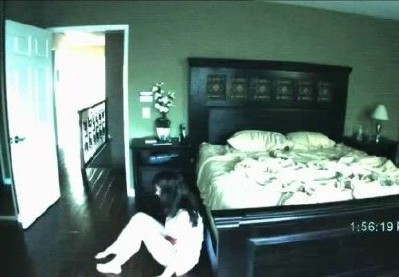
Paranormal Activity review

Having sold $7 million in tickets over the weekend despite playing in only 160 theaters, Paranormal Activity is already a huge hit. It's already received a good deal of mythologizing news coverage, and thanks to a grassroots Internet campaign where people cast votes to bring the movie to their city, is probably ingrained enough in the mass consciousness now to get a wide release in the next couple of weeks. Paranormal Activity tells the story of Katie and Micah, a young couple played by two unknown actors named Katie and Micah, who begin video-recording their home life in the hopes of capturing the supernatural events that have been happening to them at night and have seemingly followed Katie around for her entire life. The onscreen action unfolds entirely from the point of view of the couple's camera, and Katie and Micah are the only significant characters who appear onscreen, with the exception of a "ghost expert" who only appears briefly. The film's naturalistic camera work, sound design, and judiciously paced scare moments ramp up the sense of tension throughout, focusing particularly on the characters' growing unease with their surroundings.

Let's stop a minute and acknowledge that the details of Paranormal Activity, from the style right down to the marketing, are extremely reminiscent of 1999's mega-hit The Blair Witch Project. And indeed, I think that your feelings about The Blair Witch Project will probably prove to be the best predictor of how you'll respond to Paranormal Activity, at least in terms of how scary you'll find it to be. I know people who were genuinely frightened by The Blair Witch Project, but to me it came off like an hour and a half of rustling leaf sounds and vaguely spooky stick men capped off with a two-and-a-half second death scene. Similarly, I could tell that a lot of people in the theater watching Paranormal Activity with me (a surprisingly big crowd, given that I went to an 11:15 AM showing) were really scared, but the movie never really rose to that level for me. Even though it builds tension effectively, and has some very creepy moments, I wasn't ever really able to make the mental leap from "door closing unexpectedly" to "abject terror." I think that's more of a reflection of what I find scary than the an indictment of craft on display in Paranormal Activity, and I expect that my opinion of this aspect of the film will be in the minority.

Unlike The Blair Witch Project, however, Paranormal Activity has other virtues beside scare value. First of all, it really nails the intended naturalistic feeling, particularly in the acting. Katie and Micah are among the most believable couples I've seen in a modern film. Katie Featherston's performance is particularly phenomenal, in how her work never feels like she's playing a character in a film. I found myself liking both Katie and Micah quite a bit, which is a positive contrast to how I felt about the main characters in both Blair Witch and Cloverfield. Also, the plot smartly makes the issue of the camera a way of exposing the dynamic between the two main characters; Micah insists on it over Katie's objections and takes a flippantly combative tone toward the haunting that's completely discordant with Katie's emotional turmoil. As the film progresses, their different approaches to the issue increasingly drive a wedge between them.

On a certain level, Paranormal Activity almost plays like an art-house breakup drama with a ghost story in the background. Even thought it's reasonably clear that this was part of the intent, I wish the creators of the film had played up these elements even more. In particular, there's a kinda-foreshadowed plot development in the last five minutes of the film that could have easily been introduced earlier in the third act, which in turn might have opened up more of an arc for Micah's character (I may expand on this more in a post in a couple of weeks once the movie goes wide, so as not to spoil it - watching Paranormal Activity really made me reflect on what I find scary in movies). It's a bit of a nitpicking criticism, but I think that if Paranormal Activity did as good a job of resolving the haunting/relationship trouble parallel as it did setting it up, it'd have a shot at being a real classic. As it stands, it's a very well-crafted horror film that's worth getting excited over. Don't succumb to the coming hype about it being the scariest movie ever made (or the inevitable coming backlash against its overexposure, for that matter) because it isn't. It is, however, a worthwhile movie that's probably best experienced on the big screen with a large audience, and if you think you're interested, I'd suggest that you get together with some friends and go as soon as it opens near you. If nothing else, it'll make for a hell of a fantastic alternative to Saw VI.

Sunday, October 4, 2009

Zombieland review

Zombieland is the best kind of B-movie: the kind that knows full well that it's a B-movie. Pretty much everything about this flick exudes a big-hearted "slapped together for maximum fun" quality, right down to the casting of Jesse "Michael Cera was busy" Eisenberg and Woody "Matthew McConaughey was too expensive" Harrelson in the lead roles. And damned if Zombieland doesn't pull it off by making all the right choices: keeping the running time down to a drum-tight 80 minutes, keeping the non-zombie members of the cast down to the four leads and one priceless cameo (way too good to spoil here), not overselling the romantic subplot or lingering on the "dramatic" moments. Despite the shot I took at Eisenberg and Harrelson not two sentences ago, they do have a great dynamic here, and Woody in particular is obviously having the time of his life spewing one-liners as the badass killing machine Tallahassee (the characters are all named after their home cities because proper names would invite emotional bonding, a Zombieland no-no).

Probably the most impressive thing about Zombieland is it manages to be clever and fun despite the fact that zombies have basically been done to death cinematically. Zombieland actually doesn't even bother with the traditional horror elements of zombie cinema; it goes straight for action-comedy, milking the lead characters bonding under duress to sustain the narrative. This, of course, puts it in dangerous territory by inviting comparison to Edgar Wright's modern classic Shaun of the Dead, but that's really not what Zombieland is going for tonally and I didn't find myself making that mental comparison while watching it. Instead, Zombieland plays like a loose mash-up of the road-trip genre, Evil Dead 2, and Dead Rising, the great Xbox 360 game from 2006. Most of Zombieland's best moments come directly out of that playful spirit, like the awesome credit sequence (hyper slow-motion scenes from the zombie apocalypse soundtracked to Metallica's "For Whom The Bell Tolls") and the running gag of superimposing Jessie Eisenberg's neurotic character's rules for zombie survival on the screen at relevant moments.

Zombieland isn't going to rewrite the rules of genre movies, and it probably won't become a midnight movie classic (although it very well might), but it's so much fun that it's an easy recommendation. This is the type of movie best seen with a raucous audience in a crowded theater; the type you'll probably watch all the way through without really even intending to if you catch the opening of it when flipping through cable channels in a couple years. It'll put a smile on your face, and that's not an accomplishment to be taken lightly.

Also not an accomplishment to be taken lightly, the trailer for Legion, which played before Zombieland, made me think that I owe the makers of Law Abiding Citizen an apology.

Monday, September 7, 2009

On Further Viewing...Fight Club


With the end of the decade rapidly approaching, I've been thinking more and more about how the last ten years have affected my outlook and taste. Since I've amassed a pretty decent collection of DVDs dating from the early 2000s, I've decided that it would be fun to revisit the movies that I liked back around the beginning of the decade to get a critical look at how well they've held up. This is the second of the series.

The movie: Despite being a money loser theatrically, Fight Club achieved a sort of instant cultural ubiquity among my early 2000s demographic of late-adolescent college males. Fight Club's reception and cultural legacy, which I'll discuss it more below, is at least as interesting as the film itself.

My reaction at the time: When I saw Fight Club in the theater, I liked it quite a bit but had mixed feelings about the third-act twist (again, more below). By the time it came out on home video, though, I had become a full-fledged member of the cult of Fight Club. It was one of the first movies I bought on DVD (by the way, early '00s DVDs look terrible on modern HDTVs), and I've seen it who-knows-how many times, although when I watched it this evening, I hadn't viewed it since probably 2004.

On further viewing: Fight Club is one of the best movies of the 1990s, and from an artistic and thematic standpoint, is one of the most singular American films ever made. After re-watching it, I'm fairly convinced that the late 90s is the only historical period that could have produced Fight Club; the violence and subtle thematic complexity would have been toned way down if it were made five or ten years prior, and no post-9/11 studio movie would ever end with the protagonist watching a landscape of collapsing skyscrapers.

Beyond the content concerns, a good deal of Fight Club's themes are difficult to separate from the cultural context of the late 1990s. Fight Club was made in the late-Clinton years, when the Dow Jones was valued at roughly 90 trillion points, the national unemployment rate was at 4%, and the most pressing political issue of the era was the president copping a blowjob on the side and then lying about it. As a result, Fight Club deals largely with the ennui the characters experience as a result of the fact that they live in a culture that is unprecedentedly safe, predictable, and homogenous, which was for the most part, the way life was in that era.

Ten years on, that's not the culture we live in anymore. When a significant portion of young America is serving in one of two foreign wars (or dealing with the aftermath), the angst and displacement of the comfortable are necessarily far less pressing issues. Even for those not in the military, American culture in the last seven or eight years has been defined far less by safety and comfort and far more by combativeness and stridency, to the point where the president of the United States can't give a boilerplate speech about responsibility to schoolkids without sparking a political firestorm. I don't know if 18 year old kids today connect with Fight Club the way they did in 1999 (maybe they do -the fact that it's #19 on the user-rated imdb top 250 has to mean something), but I think that a big part of the immediacy Fight Club held then has been lost in the post-9/11 shift.

This isn't to imply that Fight Club can't be appreciated by first time viewers today. I love Citizen Kane, and I wasn't born until more than 40 years after William Randolph Hearst's stranglehold on American print media ended. (And yes, I did just compare Fight Club to Citizen Kane, and I'll do it again in a couple paragraph's time.) Fight Club's exploration of heady topics like radicalism and masculinity don't come with an expiration date. Beyond that, the movie's plain fun to watch; it's got a wicked, sly sense of humor, a distinct visual style, and two great lead performances by Brad Pitt and Edward Norton. Pitt's iconic Tyler Durden gets the lion's share of the attention, but Norton is the linchpin of the movie; he has to serve as the audience's surrogate for the experience of being involved with Tyler Durden without coming across as a bland or blank character, and he pulls it off so masterfully that one can almost miss the fact that his character in the movie doesn't even have a name.

It's impossible to engage in a discussion of Fight Club without noting that it's one of the most widely misinterpreted movies ever made. A substantial proportion of Fight Club viewers, including both detractors and many of the film's most devoted fans, see the movie as being on some levels an endorsement or approval of Tyler Durden's pseudo-anarchist philosophy. Roger Ebert's 1999 negative review, which underrates the film substantially in my opinion, is nonetheless extremely prescient in predicting this. The most amazing thing about how widespread this point of view is that it requires one to literally disregard the entire third act of the film after it's revealed that (spoiler alert, but come the fuck on, you've seen this movie) Tyler Durden is actually the narrator's alternate personality and the narrator embarks on a frantic quest to undo everything that he's spent the entire movie setting up.

The fact that Fight Club will probably be forever tarred with inspiring the kind of nihilistic idiocy and pedantic radicalism it critiques is unfortunate, but it serves to highlight one of the film's greatest strengths. Fight Club understands that Tyler Durden's "fuck society" mentality is tremendously seductive, particularly for young men still in the process of establishing their social identity. Rather than watering this fact down to set up the narrator's eventual enlightenment for the easy win, the film goes for broke in ensuring that the audience has the same reaction to Tyler Durden that the narrator does. The fact that Tyler is played by a notorious Hollywood hunk at his absolute physical peak is not a minor detail, and thematically speaking, the character-reversing twist is completely necessary. Maintaining Tyler Durden as a separate character would turn Fight Club a movie about peer pressure, rather than one about responsibility and moral identity.

The unfortunate side effect of the character split is that it makes for a jarring shift in tone that leads to somewhat of a dip in the initial experience of watching the film's climax. Even though the Tyler-narrator duel is thematically resonant, it's admittedly pretty goofy to watch Edward Norton beat himself up from the perspective of a parking garage security camera. By the time the narrator finally defeats Tyler Durden by shooting himself in the mouth (and surviving), someone less favorably disposed to the film than I am could credibly claim that Fight Club has ditched narrative coherency in favor of psychoanalytic fuckery. It's here that I bring in Citizen Kane for the second time to point out that one could make the same argument about 'Rosebud' being a sled, with the obvious caveat that this reveal in Kane came five seconds before the credits rather than thirty minutes.

If a central message of Fight Club can be identified, it's this: if you want to make radical choices, be careful that the alternative isn't the same thing or worse. This point is hammered home again and again over the course of the movie: Tyler Durden's individuality-seeking disciples become drone-like "space monkeys", the fight club is conceived as a rejection of touchy-feely support groups and winds up with the same hugging and crying, and the narrator's alternating attempts to reject and attract Marla Singer always wind up having the opposite effect. It's a message that in some respects, one needs to grow into; I have to confess that when I first saw Fight Club as a senior in high school, I thought Tyler Durden was awesome and that the ending of the movie was sort of confusing and disappointing. Looking back now, I find it somewhat comforting that the Tyler Durden-quoting campus radical might one day revisit his (you know that this person will invariably be male)
favorite movie and find that there's more to it than initially met the eye.

Still worth seeing? Most definitely. Just please don't start beating on your friends or vandalizing Starbucks stores afterwards.